
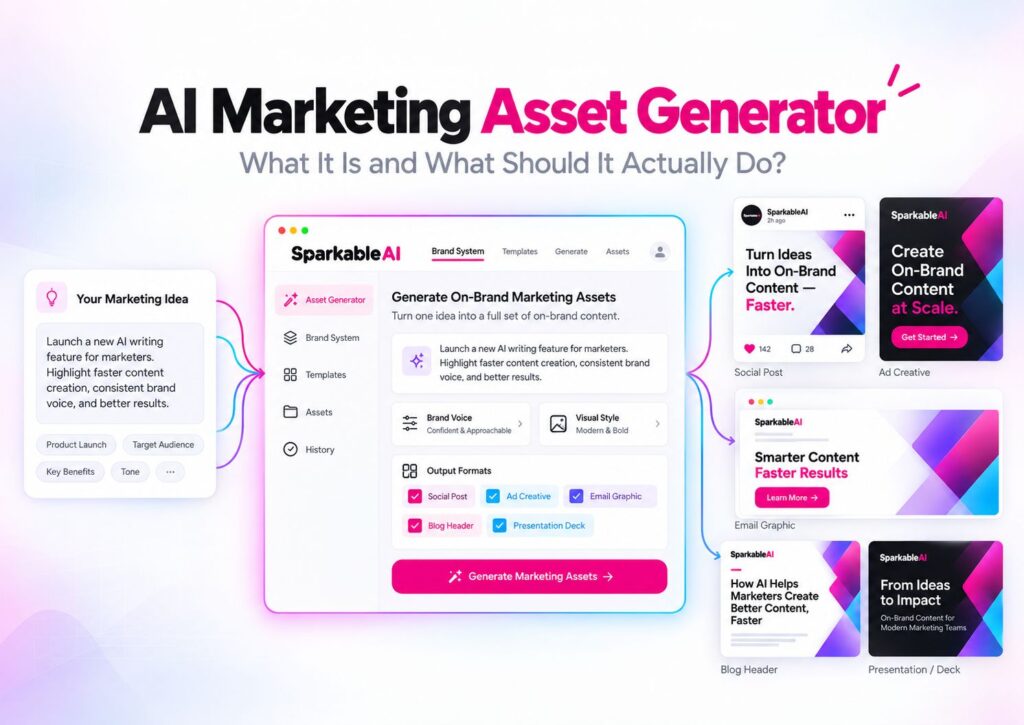
Why Brand Consistency Is the Real Challenge for AI Marketing Generators
An AI marketing asset generator can produce ad copy, social graphics, campaign images, and other AI marketing assets in minutes. AI-powered marketing delivers content up to 84% faster than traditional methods. That speed is real and measurable. What gets sacrificed when volume scales faster than oversight is brand consistency: the single quality that tells investors, customers, and partners that a company knows who it is.
For early-stage startups, brand identity is not decoration. It is credibility. Every mismatched logo treatment, every off-tone caption, every color that drifts from the approved palette signals that the company has not figured itself out. An AI brand asset generator produces at scale. It does not necessarily track what that scale does to your identity.
Volume Vs. Consistency: The Trap Inside the Speed Gain
More content creates more chances for things to go wrong.
AI-native startups now dominate the tech conversation, and many are built from day one on tools that automate their AI content creation and marketing operations. The efficiency argument is straightforward: if an AI marketing asset generator cuts production time by 84%, a two-person founding team can produce at the volume of a larger marketing department. Instead of hiring a designer for every campaign asset, the founders run the AI and ship.
This logic holds until it does not. Approved color palettes, precise logo usage, defined tone of voice, specific typographic choices: these elements function as brand signals only when they appear the same way, every time. Generate fifty assets with an AI design generator and you will see fifty small variations. A slightly different shade of blue. A headline that sounds enthusiastic where your brand is dry and authoritative. An image style that worked for the last campaign but conflicts with the one running beside it.
The volume gain accelerates this drift. A team producing five assets a week will catch inconsistencies in review. A team producing fifty will miss them because the review process has not scaled with the output. The 84% speed increase that platforms cite applies to production time, not quality control time. That distinction matters.
The counterargument is tempting: if AI handles content volume, founders can redirect time to product, sales, and fundraising. That is only true if the AI marketing content requires no correction. When brand drift compounds unchecked across channels, the cost of fixing it later exceeds the time saved upfront. Investors who see three different visual identities across a startup’s website, pitch deck, social channels, and sales enablement content draw a specific conclusion: this team is not in control of its narrative.
The AI-Brand Gap: Where the Tools Stop Short
Generative AI is effective at creating new content and insights for marketing purposes. That AI content creation capability is not the same as brand comprehension. A founder who has spent months building a brand voice knows the difference between “confident” and “aggressive,” between “minimal” and “cold.” That distinction lives in judgment. It does not transfer cleanly into a prompt.
Most AI branding and creative platforms accept brand inputs in the form of uploaded style guides, color hex codes, and font selections. These are useful constraints. They are not sufficient. Brand guidelines encode reasoning: why these colors, what they signal, which contexts call for restraint versus energy. An AI brand generator can apply the rules it receives. It does not necessarily know why the rules exist or how to apply them to situations the guidelines did not anticipate.
This is where misalignment happens. A startup’s brand guide may specify “professional but approachable” as a tone descriptor. That phrase means something precise to the founding team. Translated into AI output, it produces results ranging from stiff corporate copy to something that reads like a casual Slack message. Neither is technically wrong by the rules in the system. Both may be wrong for the brand.
AI marketing asset platforms are optimized for throughput. The architecture often rewards speed of output, not fidelity to intent. A founder treating an AI marketing asset generator as a fully autonomous system rather than a production assistant requiring oversight will eventually publish something that contradicts the brand they are trying to build. Human oversight is the mechanism that catches what rule-following cannot.
Ensuring Brand Consistency: What Founders Can Actually Control
Brand integrity under AI requires structure before output, not review after the fact.
The first step is building machine-readable brand guidelines. Style guides written for human designers rely on qualitative language and visual examples. AI tools and brand consistency software need explicit, structured inputs: exact hex codes, approved font names, tone descriptors mapped to specific content types, and clear rules about what to exclude. A guide that says “use blue” is not a constraint. A guide that specifies the exact hex value and identifies which asset types use it is.
The second step is templating. Rather than generating assets from a blank prompt each time, founding teams should lock down approved layouts inside their AI creative platform. Templates constrain the output space, and constrained output space means fewer inconsistencies reach publication. AI brand asset generation works most reliably when the generative space is deliberately narrow.
The third step is a human review gate supported by an AI brand consistency tool where possible. This does not require a full-time brand manager. It requires a designated decision-maker who reviews AI-generated assets before they publish, working from a short checklist against the brand guidelines. AI tools that flag deviations from uploaded brand parameters reduce what reaches that gate, making review faster and more targeted.
The fourth step is a regular brand consistency audit. Reviewing a sample of published AI marketing assets every two weeks catches drift before it compounds across channels. If a color, visual style, logo treatment, or tone has shifted, a biweekly brand consistency audit finds it early enough to correct without a full rebrand exercise.
No AI marketing asset generator on the market removes the need for human judgment on brand decisions. The strongest model combines the speed of AI content creation with structured brand rules, brand consistency software, and human oversight. Startups that understand this build workflows where AI handles production speed and humans hold the line on identity. That is not a workaround. It is the functional model for AI-generated marketing at the quality level investors and customers expect.