
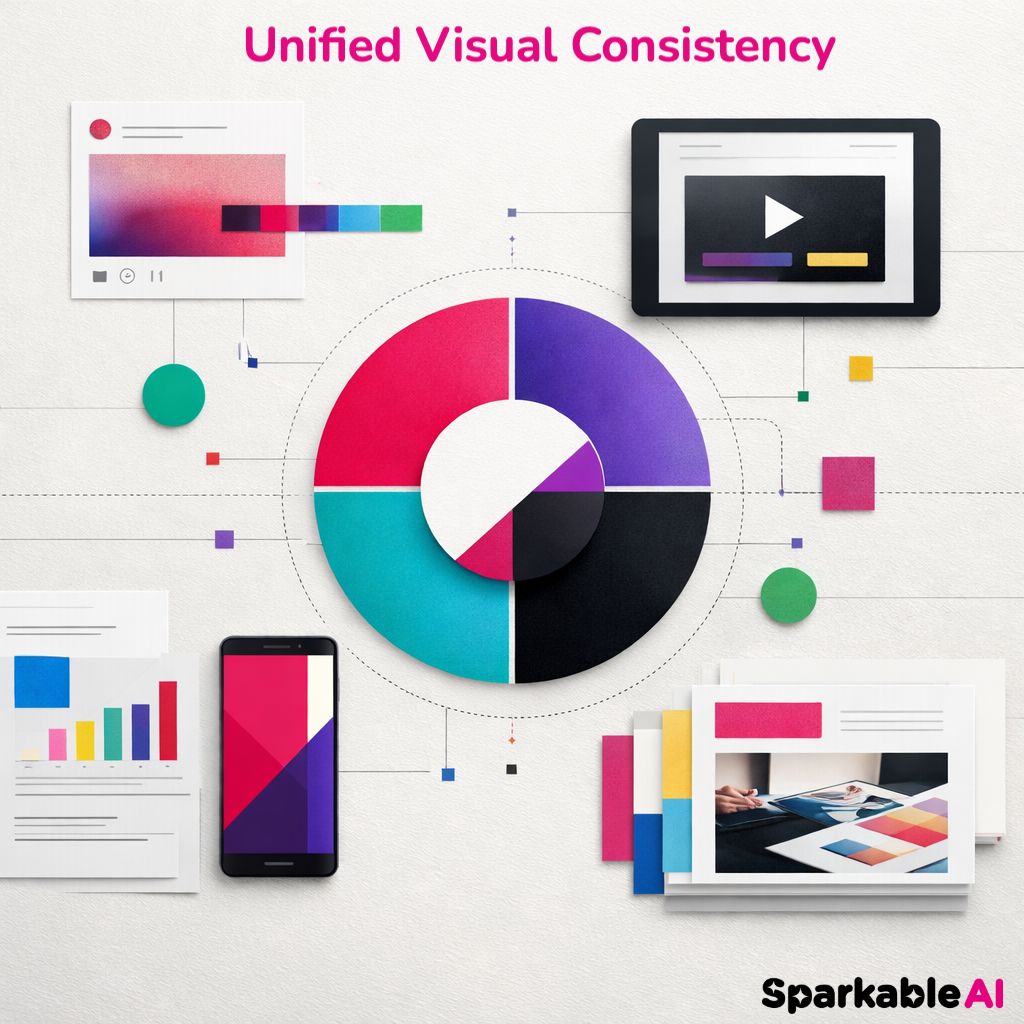
Beyond Volume: Solving Brand Inconsistency with AI
83% of creatives now use AI to accelerate production. Volume is solved. Brand consistency is not. When every designer pulls from a different folder, every freelancer references a different logo version, and every campaign ships with slightly different typography, the damage compounds silently across channels. AI brand identity systems exist to stop this, but only if the underlying brand identity design and brand architecture are sound enough to enforce.
The problem becomes more visible as a company grows. An early-stage team may have one founder approving every social post, presentation, and sales asset. Add a marketing lead, freelance designer, agency, sales team, and multiple AI tools, and suddenly five different people or systems are making creative decisions on behalf of the same brand.
Each decision may look reasonable in isolation. Together, they create inconsistency.
One campaign uses the right colors but the wrong typography. A sales presentation uses an outdated logo. Social content introduces an illustration style that never appears on the website. An AI-generated ad follows the right message but looks nothing like the rest of the campaign.
The problem is not necessarily bad design. It is the absence of a system connecting every creative decision back to the same brand foundation.
Identify Fragmentation
Scattered tools produce scattered assets. Briefs live in email threads. Feedback moves through Slack, then a PDF, then a verbal revision no one documents. Monday.com’s research on creative workflows identifies this exact pattern: fragmented briefs and broken feedback chains generate delays and off-brand output. The root cause is ownership without accountability. No single system holds the authoritative version of brand guidelines, visual identity design, and approved assets, so every contributor works from a different assumption. That is not minor variation. It is drift that erodes recognition across every touchpoint.
AI can amplify that fragmentation.
Give five people access to an AI design tool and they can suddenly produce dozens of assets independently. The speed is valuable, but without shared brand constraints, every person is effectively interpreting the brand again from scratch.
One marketer prompts for “clean and modern.” Another asks for “bold and innovative.” A freelancer references last year’s campaign. A sales team member uploads an old presentation as inspiration. Each input sends the AI in a slightly different direction.
The result is more content, but not necessarily a stronger brand.
This is why creative workflow problems cannot be solved simply by adding another generation tool. Before a company automates creative production, it needs to establish what the system is supposed to protect.
AI Brand Identity: Building the Unified System
A centralized AI brand identity system is not a shared drive. It is a single source of truth governing color, type, tone, and asset structure across every output. SparkableAI converts brand inputs into reusable, on-brand assets and removes the agency dependency that slows most teams. Teams without a defined visual identity will hit a wall here. AI brand design enforces rules. It does not invent them. Define your brand standards first, then scale them.
That distinction matters.
A folder containing logos and a PDF brand guide is a repository. A brand system should actively influence what gets created.
The system needs to understand which logo variation belongs on dark backgrounds, which colors are primary versus supporting, which typography combinations are approved, what imagery feels appropriate for the brand, and what kinds of visual treatments should never appear.
It should also extend beyond visual identity design.
Brand identity includes tone of voice, messaging hierarchy, audience, positioning, and the relationship between different asset types. A LinkedIn carousel, sales presentation, paid advertisement, email graphic, and website hero should not look identical. They should, however, clearly feel like they came from the same company.
This is where an AI brand identity system becomes more useful than a static brand guide. Instead of requiring every contributor to interpret the guidelines correctly, the system can carry those decisions into the creative workflow itself.
What Should the Single Source of Truth Contain?
At minimum, the system should contain the core elements of brand identity design: approved logos and logo usage, primary and secondary colors, typography, imagery style, iconography, graphic treatments, layout principles, and visual examples.
But effective AI brand design requires more context than a traditional brand kit.
It should understand which combinations are preferred, where exceptions are allowed, and how the brand changes across channels. It should know that a certain typeface is appropriate for headlines but not body copy. It should distinguish between a high-energy product launch and an investor presentation where the same brand needs to feel more restrained.
This is also why an AI brand kit generator should be viewed as a starting point rather than the entire solution. Generating a logo, palette, fonts, and basic guidelines helps establish the foundation. Maintaining the identity requires those decisions to remain connected to everything the company creates afterward.
The brand kit cannot become another PDF that gets forgotten in a folder.
It needs to become operational.
Leverage AI Efficiency
Once the brand system exists, a creative automation platform executes it without drift. AI applies identical color values, font weights, and layout logic across every channel. Individual creative input still matters inside those constraints, the same way architects work within structural codes. SparkableAI turns brand inputs into governed asset templates, functioning as more than an AI brand kit generator by ensuring each campaign starts from the same approved brand identity design rather than a freelancer’s interpretation of the logo.
That does not mean every asset should look the same.
Consistency and repetition are different things. A strong brand system creates enough structure for recognition while leaving enough flexibility for creativity. Campaigns can introduce new compositions, photography, messaging, or formats without abandoning the underlying identity.
This is where AI brand design can become particularly valuable. Instead of asking AI to invent a new creative direction with every prompt, the platform can generate within an established creative territory.
The question changes from “What should this look like?” to “How should our brand express this idea?”
That is a much more useful role for AI.
From Brand Guidelines to Brand Guardrails
Traditional brand guidelines tell people what they should do. AI-powered systems can increasingly turn those guidelines into guardrails.
If the approved palette contains six colors, the system should prioritize those colors rather than improvising new ones. If a logo requires specific spacing, generated layouts should respect it. If the brand avoids certain visual clichés or imagery styles, those exclusions should influence generation as strongly as the approved elements.
The same principle applies to messaging.
A brand described as confident, intelligent, and direct should not suddenly become overly playful because someone asked an AI tool to “make the caption more engaging.” The system should interpret that request within the existing identity rather than overriding it.
That is the difference between using AI for isolated asset generation and building an AI brand identity system.
One produces content. The other produces content within context.
Human Judgment Still Defines the Brand
AI can enforce consistency, but people still need to decide what deserves to become consistent.
Founders, brand leaders, marketers, and designers establish the creative direction. They decide whether the brand should evolve, whether a campaign can intentionally break a rule, and whether an unexpected AI-generated direction is worth exploring.
The goal of an AI-powered creative workflow is not to remove those decisions. It is to remove the repetitive interpretation required between them.
Instead of asking every freelancer, marketer, and AI tool to independently understand the brand, the organization establishes the identity once and gives contributors a shared system from which to work.
Human judgment defines the boundaries. AI helps maintain them at scale.
One Brand, Many Creators
As creative production becomes easier, the number of people capable of producing brand assets will continue to increase. Founders can create ads. Sales teams can build presentations. Marketers can generate social campaigns. Freelancers and agencies can move faster.
That democratization is useful, but it makes the single source of truth more important, not less.
The future creative workflow is unlikely to have one person creating everything. It will have many people and AI systems creating simultaneously. The companies that maintain a recognizable identity will be the ones that connect all of that production to the same underlying brand intelligence.
Brand consistency is the harder problem. Solve it with structure, then let AI brand design help hold the line.