Brand Refresh vs. Rebrand: Which Does Your Growing Business Need?
What a brand refresh changes
A refresh updates how an established brand expresses itself while retaining the core identity customers should continue to recognize. The name and central positioning may remain, while the typography, color relationships, imagery, messaging, and applications become more coherent.
Consider a hypothetical accounting firm that has expanded from individual tax preparation into advisory services for business owners. Its name still fits, and its local reputation remains valuable. A refresh could strengthen its service messaging, improve the visual hierarchy, and replace disconnected materials with a consistent identity.
The objective is to represent the business more accurately without discarding useful recognition.
When a full rebrand makes more sense
A rebrand revisits more fundamental decisions about who the company serves, what it stands for, and how it should be understood. Depending on the project, this can include the name, positioning, verbal identity, and visual system.
A hypothetical software company moving from a consumer scheduling tool to an enterprise operations platform may need that deeper work. Updating the logo would leave the larger positioning question unresolved.
Ask whether the existing brand can credibly carry the future business. If the answer requires repeatedly explaining away the name, promise, or category association, investigate the foundations before polishing the expression.
Diagnose the problem before choosing the scope
Review recent sales conversations, customer questions, and the materials people encounter before contacting you. Look for specific evidence of a mismatch.
Do prospects misunderstand the service or product category?
Does the identity suggest a different price level or audience from the one you serve?
Are inconsistent assets the main problem, despite a clear offer?
Would retaining the current name and central message limit the next stage of the business?
These questions separate an execution problem from a positioning problem. Neither a founder’s boredom with the logo nor a competitor’s redesign is sufficient evidence on its own.
Compare the work beyond the logo
Request a scope that identifies strategic decisions, design deliverables, and rollout requirements separately. Adobe’s brand guide describes an identity system spanning visual rules and voice, a useful reminder that the logo is only one part of the work.
For either approach, identify the touchpoints that must change: website, proposals, social profiles, email signatures, packaging, presentations, and customer communications. A modest design update can still require a substantial rollout if the business has many applications.
Also ask who will maintain the system. A beautiful identity that only its original designer can apply leaves the team with a continuing operational problem.
Choose the smallest scope that resolves the real mismatch
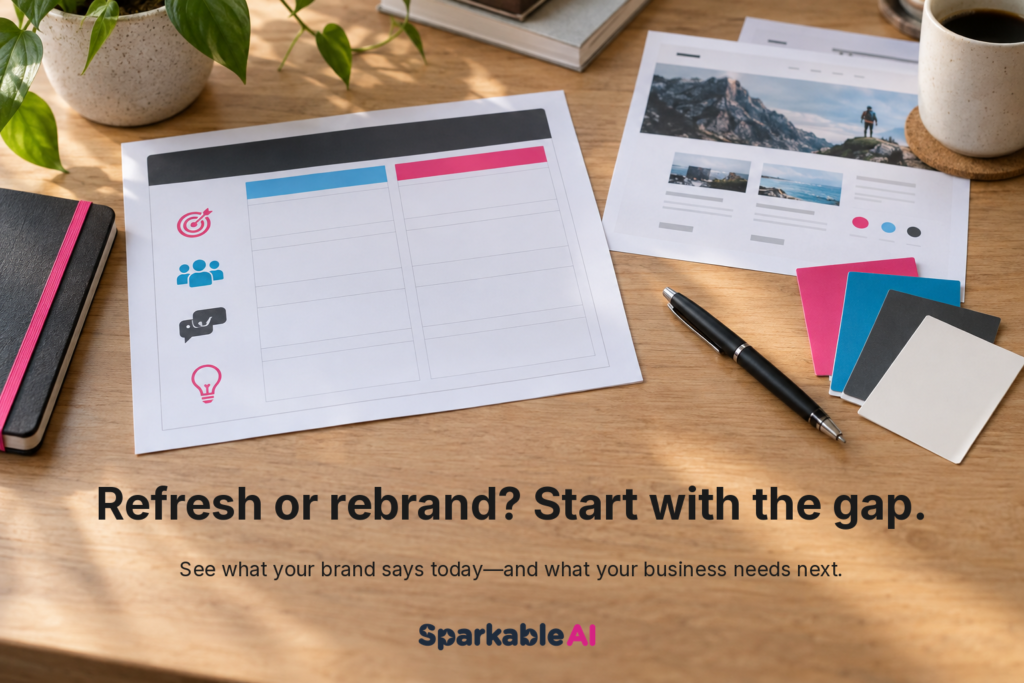
Write a short statement before speaking with a creative partner: “Our brand currently communicates X, but the business needs to communicate Y.” Add examples that demonstrate the gap.
That statement provides a better starting point than asking for a modern logo. It also gives you a practical way to assess the work when it arrives.
If you are unsure how deep the change needs to go, start with a SparkableAI brand audit. Understanding what to retain is as valuable as identifying what to change.
Tell us a bit about your team and what you are looking to build. We will reach out to discuss the right Enterprise plan for your needs.
Collateral Creation Request
Need help creating high-quality marketing, sales, or brand assets? Share a few details and our team will help you plan the right collateral for your business.
Contact Sales for Enterprise Plan
Tell us a bit about your team and what you are looking to build. We will reach out to discuss the right Enterprise plan for your needs.