
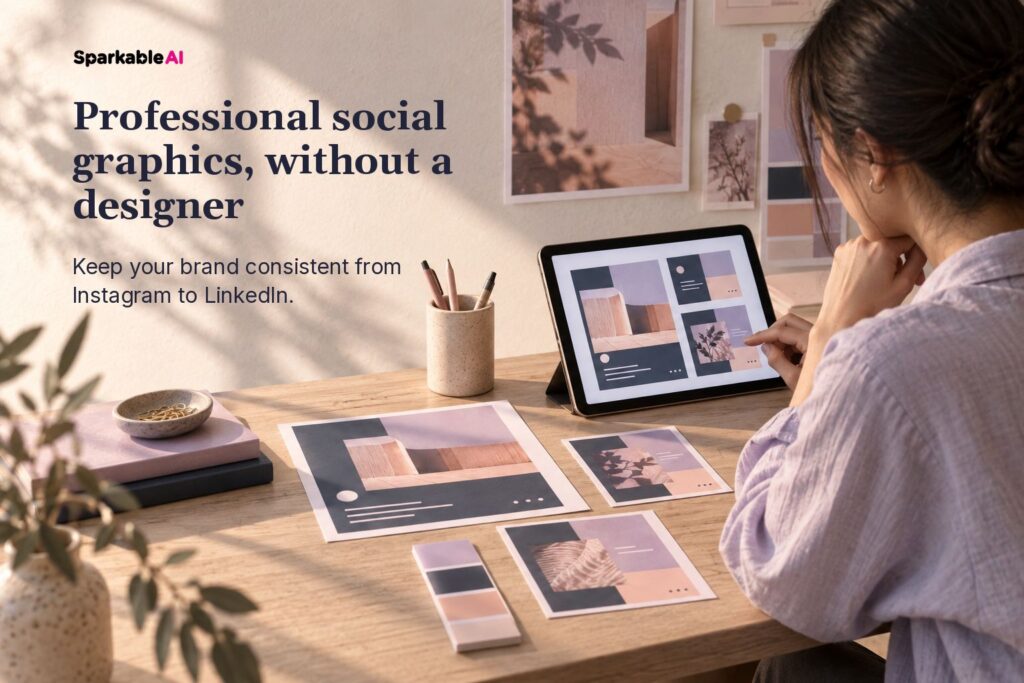
From Ideas to Professional Social Media Graphics: How AI Ensures Brand Consistency
Startup founders can create professional social media graphics with AI in minutes. That speed is real. But speed alone produces a feed full of mismatched visuals that erode the credibility a young brand is trying to build. The actual advantage AI offers is not volume. It is consistency: the ability to produce on-brand content at scale without a design team on payroll.
That distinction changes how founders should choose and use AI tools.
The goal is not simply to make more posts. It is to establish a repeatable social media content creation system where Instagram graphics, LinkedIn carousels, campaign posts, and other visual assets look like they came from the same company.
Harnessing AI for Social Media Creative
Founder-led marketing carries a persistent friction: ideas are plentiful, but turning them into finished assets slows everything down. A founder who writes a sharp LinkedIn post in ten minutes spends two hours waiting on a designer, or two hours wrestling with software they never trained to use. SparkableAI has identified this gap directly: despite abundant ideas, asset execution is often the point where founders stall.
AI social media graphics generators close that gap. Platforms built for social media content creation let founders input brand parameters, select a format, and receive a finished graphic without a traditional design brief or a production queue. SparkableAI is designed to transform ideas into branded marketing assets, with on-brand content produced at scale.
This changes the workflow for social media creative design. Instead of moving from idea to brief to designer to revisions to final asset, founders can move from idea to generated creative to review. The production steps shrink, but judgment remains.
The cost reduction is structural. A single design revision cycle with a freelancer or agency burns time and budget that a seed-stage company cannot absorb repeatedly. AI Self-Serve models put production inside the founder’s own workflow. SparkableAI offers two distinct models: AI Self-Serve, which gives founders direct control over the production process, and Designer Assist, which adds a human layer when the brief is complex or the asset is high-stakes. Neither model requires a full-time hire.
An AI social media content generator can therefore solve a real production problem for a growing company. But generating an asset is only half the job. The asset still needs to look like the company that published it.
Speed is the entry point. Consistency is the product.
Creating Professional Social Media Graphics Across Platforms
A startup’s Instagram assets, LinkedIn graphics, and other social media marketing graphics rarely share a designer, a template, or a brief. Each gets produced under different time pressure, often by different people. The result is a brand that looks slightly different depending on which platform a prospect encounters first.
That visual fragmentation signals immaturity, not agility.
Brand consistency is the right lens through which to evaluate any AI LinkedIn post design tool, AI social media content generator, or social media asset generation platform. Not output volume. Not template variety. Consistency.
That does not mean every platform should receive an identical design.
Instagram, LinkedIn, and other social channels have different formats, audiences, and viewing behaviors. A LinkedIn carousel may need more structured information and typography, while an Instagram post may rely more heavily on visual impact. Good social media creative adapts to the channel while retaining the visual signals that make the brand recognizable.
Colors, typography, logo treatment, imagery style, graphic elements, and tone should create continuity even when the format changes.
The counter position deserves a direct answer here: AI does produce generic outputs when it has nothing specific to work from. A tool that does not know your typeface, your color palette, your tone, or your visual hierarchy cannot enforce any of them. The output will be competent and forgettable.
That is a real limitation, not a theoretical one, and founders who skip the setup step will discover it quickly.
The solution is to front-load the brand inputs. Platforms that allow founders to encode their brand identity before generation begins—specifying colors, fonts, logo placement, tone, and preferred imagery—can apply those constraints to every asset they produce.
The AI does not have to reinvent the brand with every prompt. It executes within boundaries the founder defines.
The difference between generic AI social media graphics and recognizable, on-brand output is largely determined by what the founder puts into the system before clicking generate.
SparkableAI offers a free AI Brand Design Audit that evaluates a brand’s visual identity, messaging, consistency, and readiness. That audit functions as a diagnostic before a founder commits to scaling production. Knowing where consistency is already breaking down tells a founder which parameters need to be locked before producing more content.
Running the audit first means the AI can work from a stronger brief rather than filling gaps with defaults.
Manual oversight does not disappear in this model. A founder still reviews outputs. But the review catches edge cases, not systematic drift. That is a different kind of work: quality control rather than creative direction from scratch on every asset.
Integrating AI Into Your Social Media Content Creation Strategy
Adopting an AI graphics tool without a brand foundation produces faster versions of the same inconsistency problem. The integration step is not technical. It is strategic, and it comes before any tool is opened.
Start with what is already defined. If brand guidelines exist only in someone’s memory, extract them before touching any AI tool. Color codes, font names, logo clear space rules, imagery preferences, and the three words that describe your tone: write them down.
These inputs become the parameters that constrain AI outputs and prevent the generic-output failure described above.
Then determine what kinds of social media marketing graphics the company actually needs. A startup may require LinkedIn thought-leadership graphics, educational carousels, product announcements, event posts, customer stories, paid social ads, and promotional campaign assets.
Defining these recurring formats creates a more structured social media content creation workflow. Instead of starting from zero every time, the team works from a recognizable set of content types governed by the same brand system.
Then match the tool model to the use case. AI Self-Serve works when the founder has strong visual instincts and clear guidelines already documented. Designer Assist works when the brief is complex, the asset is high-stakes, or the brand is still being developed.
SparkableAI’s two-model structure reflects this distinction, and choosing the wrong model for the situation can be a source of poor results even with a capable platform.
Build a Repeatable Social Media Creative System
The next step is moving beyond individual graphics.
Creating one professional post with AI is easy. Creating 30 pieces of social media creative that remain recognizable across a month is the harder test.
That requires a system.
Establish approved visual treatments for recurring content types. Define how educational posts differ from product announcements. Determine where logos appear. Establish which colors dominate and which act as accents. Decide how photography, illustration, typography, and graphic elements should be used.
An AI social media content generator can then work inside those boundaries rather than inventing a new creative direction every time someone enters a prompt.
This is particularly important when more people begin creating content. A founder may initially control every asset. Later, a marketing lead, social media manager, freelancer, or agency may join the workflow.
The underlying brand rules should not change depending on who clicks generate.
That is the difference between using AI to make graphics and using AI to build a scalable social media creative design workflow.
Review Before You Publish
Establish a review checkpoint before any AI-generated graphic goes live. This does not require a designer. It requires a short set of questions.
Does this look like us? Are the colors correct? Is the typography consistent? Does the imagery fit our established style? Is the logo being used correctly? Does the tone sound like our brand?
If the answer is no, the problem may be upstream. A brand parameter could be missing or the tool could be under-constrained.
Fix the input rather than manually correcting the same problem on every output.
This feedback loop also improves future generation. If the team consistently rejects a certain imagery style or layout treatment, that preference should become part of the creative rules governing future assets.
Audit Your Brand as It Evolves
Finally, audit on a schedule.
As a brand evolves, its AI inputs must keep pace. A color palette refresh, new positioning, a different audience, or a new product line can change the visual language. Tools calibrated to the old brand will continue producing assets that reflect it.
A free AI Brand Design Audit can help identify those gaps by looking at visual identity, messaging, and consistency rather than relying on a vague impression that something feels off.
The audit should feed back into the production system:
Audit the brand → update brand inputs → generate social media creative → review → publish → learn → update again.
This turns social media content creation into a repeatable system rather than a series of disconnected design requests.
Professional Social Media Graphics Without a Full-Time Designer
The case for AI in startup marketing is not that it replaces design talent. It is that it puts consistent, on-brand execution within reach of founders who cannot yet afford a full creative team.
An AI social media content generator can shorten production. Brand parameters can protect consistency. Human review can protect judgment. Used together, they give small teams a practical way to create professional social media graphics without starting every asset from scratch or sending every post through an external designer.
Volume comes as a byproduct. Consistency is the strategy.
Founders who encode their brand parameters before scaling production can build a feed that looks deliberate across LinkedIn, Instagram, paid social, and other channels. Founders who skip that step risk producing more noise, faster.
Set the brand inputs first. Build the creative system around them. Then let AI execute.
