
From Idea to Full Campaign: AI’s Role in Modern Marketing
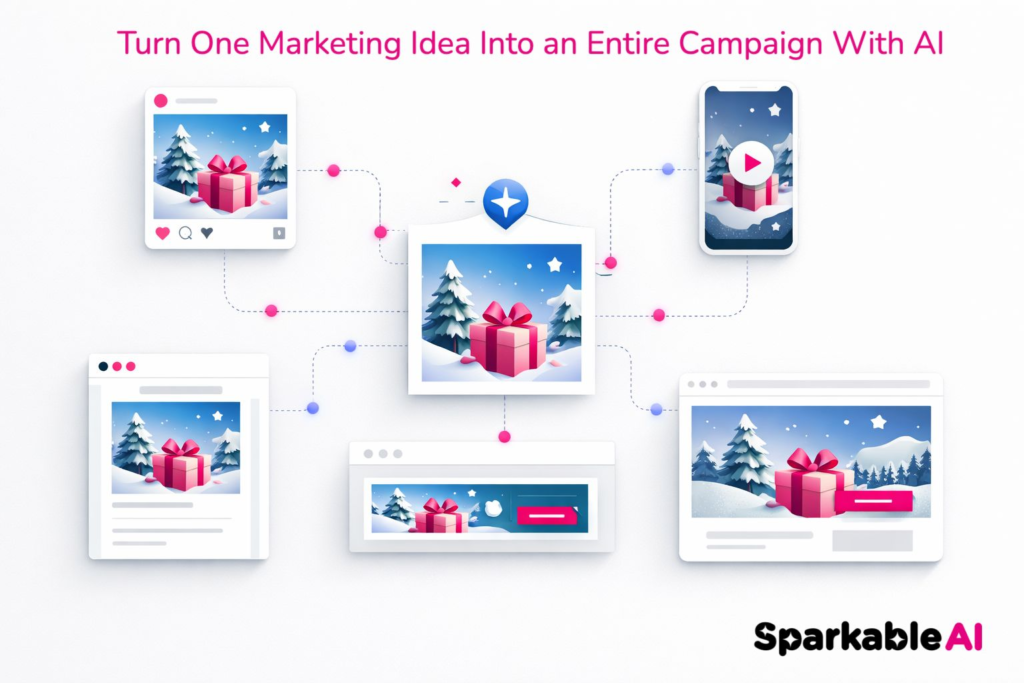
Most marketing teams do not have a content volume problem anymore. They have a consistency problem. An AI campaign generator solves the first issue quickly. Solving the second requires something no tool supplies on its own: a defined brand system. Get both right, and a single idea becomes a complete, on-brand campaign across every channel in hours, not weeks.
From Idea to Blueprint
A campaign starts before any asset is produced. It starts with a clear idea, a defined audience, and measurable objectives. AI compresses the distance between that starting point and a working campaign blueprint.
Feed a well-scoped brief into an AI campaign generator, and it returns messaging frameworks, channel recommendations, content formats, and audience-specific copy variations. What previously required a kickoff meeting, a strategy session, and three rounds of alignment now surfaces in a single output. The team’s job shifts from generating options to selecting and sharpening them.
That shift matters. Strategists spend less time on logistics and more time on judgment. A campaign brief that once took two days to build can be structured in an hour. The team still defines the idea, sets the tone, and approves the direction. AI handles the mechanical expansion from concept to plan.
The critical step is specificity. Vague inputs produce vague outputs. A brief that names the audience segment, the campaign objective, the brand voice, and the call to action gives the AI enough structure to produce a blueprint worth using. Teams that skip this setup get volume without direction. That is a waste of time and budget.
This Idea phase, the first stage of the Consistent Campaign Framework, is where human judgment is most essential. The strategist defines what success looks like. The AI scales out from that definition. Without a clear starting point, the downstream generation and unification stages produce nothing coherent.
Rapid Multi-Channel AI Campaign Asset Production
With a blueprint approved, the production phase begins. This is where AI’s speed advantage is measurable and concrete.
A single campaign concept requires social posts, email copy, ad headlines, landing page text, and visual assets, often in multiple sizes and formats per channel. Producing all of that manually means queuing work through designers and copywriters, waiting on revisions, and managing version control across a team. The process is slow and expensive.
SparkableAI is built to eliminate that bottleneck. The platform generates repeatable, on-brand content rapidly, producing assets across formats without requiring a separate production cycle for each channel. A startup that once needed three weeks and a freelance roster to launch a campaign can now run the same process in a fraction of that time. SparkableAI’s tools are designed specifically to support startup growth without the production bottlenecks that typically stall scaling teams.
This is where campaign generation with AI proves its practical value. The output is not a single polished asset. It is a full set of deliverables: matched in tone, formatted for their respective platforms, and ready for review. The marketing team approves, adjusts where needed, and moves to deployment faster than any traditional workflow allows.
The Generate phase also removes a structural dependency that slows most teams: the single designer. When one person or one small team controls asset production, campaign volume is capped by their hours. AI campaign content generation breaks that ceiling. A team of two can now produce the asset volume that previously required a department, without sacrificing format coverage or channel reach.
The volume problem is solved. What remains is whether the volume is consistent.
Ensuring Brand Consistency
Speed without consistency creates a specific kind of damage. Audiences encountering conflicting visual identities, inconsistent messaging, or shifting brand tone across channels do not experience a brand. They experience noise.
This is where many scaling teams hit a real wall. As demand for assets increases, brand integrity degrades. Startups face this pattern acutely: they grow fast, produce content across channels to keep pace, and end up with a brand that looks and sounds like it was made by five different companies. SparkableAI identifies this as brand disintegration, a documented outcome when asset production outpaces brand governance.
The tool is not the fix. The brand system underneath it is the fix.
AI maintains consistency by applying rules. Those rules come from the brand: color palettes, typography, tone-of-voice guidelines, approved terminology, logo usage standards. A team that has not documented these cannot expect AI to invent them. The output will reflect the absence of structure, not compensate for it.
Teams that have a defined brand system can load those parameters into their AI workflow and expect consistent output across a multi-channel AI campaign. Teams that do not will produce volume with no coherence. That outcome is worse than low volume, because it actively erodes audience trust.
The counterpoint worth addressing directly: AI-generated content lacks the human touch needed for authentic brand storytelling. That concern is legitimate. AI does not know a founder’s origin story. It does not understand why a specific word choice resonated with an audience three years ago, or the strategic weight behind a campaign’s tone shift. That context lives with people, not platforms.
The answer is not to replace human judgment with AI output. It is to use AI to handle production while humans hold editorial control. A brand strategist or designer reviews every asset before it ships. The AI generates the volume. The human decides what goes live. Both functions are necessary, and neither replaces the other.
In practice, the Unify phase means setting review checkpoints at the end of the Generate stage and before final approval. Each asset is measured against the documented brand system. Anything that drifts gets corrected before it reaches the audience. That review loop is what separates a consistent multi-channel AI campaign from a fast but incoherent one.
Build the System First, Then Scale
A documented brand system combined with an AI campaign generator produces repeatable, on-brand campaign output at volume. That is the mechanism, and it works.
The single prerequisite: define your brand system before deploying AI at scale. Document the rules, load them into the workflow, and keep a human in the review loop at every stage. Do that, and marketing campaign creation shifts from a bottleneck-driven process to a repeatable one. The speed advantage AI offers becomes durable only when the brand system underneath it is solid.